Why insulation is the most important decision in a garage conversion
A garage is built to the minimum standard for a non-habitable structure: no insulation in the walls, no insulating layer between the floor and the living space, and no air sealing around gaps and penetrations. When you convert that space to a bedroom, office, or rental unit, bringing it up to habitable standards is not optional, and it is not just about comfort. California’s Title 24 Energy Code sets minimum thermal performance requirements for all habitable conversions, and your permit will not close without a passing compliance report.
The good news: San Diego’s climate makes garage conversions easier to insulate than many other California regions. The coastal marine layer moderates summer temperatures, and winters are mild. But “mild” still means 95°F+ summer days in Santee, El Cajon, and Poway, and overnight temperatures in the low 40s in winter in those same locations. The coastal zones from La Jolla to Encinitas to Oceanside are genuinely temperate, but even there a garage without insulation gets hot in summer and cold in winter.
The four insulation challenges in a garage conversion
1. Exterior walls with no insulation.
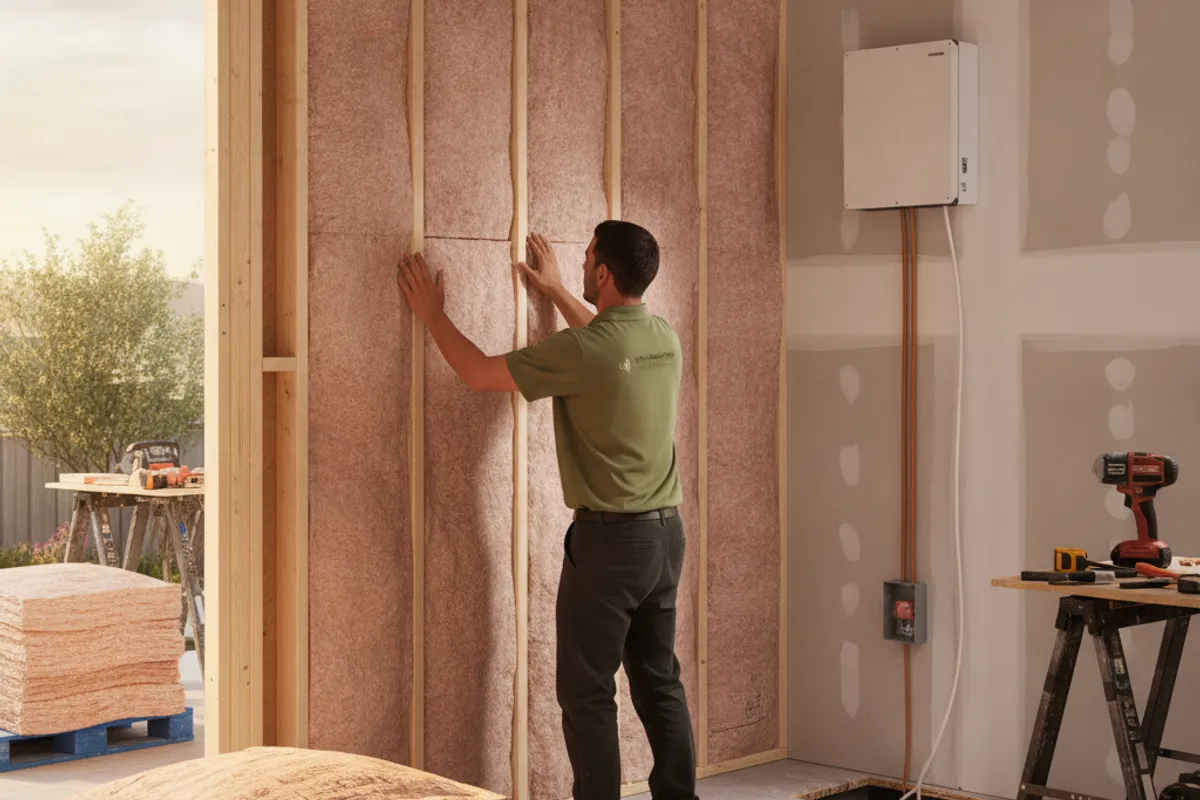
Garage walls may use 2x4 framing without insulation or interior drywall. The approved Title 24 compliance report determines the required insulation for each property. Batt insulation, including fiberglass or mineral wool, can fit between existing studs. New drywall then covers the completed wall assembly. Walls with existing drywall can be opened and insulated during construction. Other methods include blown-in insulation or continuous rigid foam along the interior face.
Blown-in insulation through small drilled holes is a lower-disruption option for walls with existing drywall, but it requires a contractor with the right equipment and is not always effective in 2x4 cavities where settling and bridging reduce coverage. Full batt insulation with new drywall is the most reliable result.
2. The garage floor slab.
A garage floor is a direct cold pathway from the ground into the living space. It is cold in winter, cool in summer, and transfers moisture from the soil when conditions are right. Building a habitable floor directly on the slab without an insulating layer produces a cold, damp floor that is uncomfortable to live on and prone to moisture damage.
A raised subfloor system can use pressure-treated 2x4 or 2x6 sleepers laid flat on the slab. A vapor barrier goes under or between the sleepers. Batt or rigid foam insulation fills the spaces between them. Plywood sheathing creates an even base for the finished flooring. The project’s Title 24 compliance report provides the required insulation values.
A simpler (and cheaper) alternative is a double layer of rigid foam panel directly on the slab, topped with plywood. This approach works for lighter uses like an office or gym but is generally not appropriate for a bedroom or full ADU because it does not provide enough height to bring the floor up to match the house level in most San Diego tract homes.
3. The garage door opening.
The garage door opening becomes a new exterior wall during conversion. That section can use 2x6 framing or 2x4 framing with continuous rigid foam. A window can provide daylight in the finished room. If the room becomes sleeping space, the plans must include compliant emergency egress.
4. The ceiling.
An unfinished garage ceiling may expose open rafters. Other garages may already have ceiling drywall. Either assembly must meet current residential and energy codes. Coastal and inland San Diego sit in different climate zones. The property-specific Title 24 compliance report provides the required values for the approved ceiling assembly.
Title 24 compliance
A Title 24 compliance report is part of the permit package. It’s prepared for the specific property and approved design. The report lists the required values for insulation, windows, and mechanical systems. Those project-specific values show how the conversion meets current residential energy codes. This site does not state that a conversion “almost always passes.”
HVAC options for converted garages in San Diego
Mini-split heat pump. A single-zone mini-split mounts the air handler on a wall inside the converted space and the compressor outside. It handles heating and cooling without new ductwork. This site does not publish installed mini-split prices or a BTU size chart. The HVAC contractor sizes the equipment from the approved plans and the load calculation.
Extension of existing central HVAC. If the house has a forced-air system and the garage is attached and adjacent to the air handler, extending a duct run into the converted space is sometimes feasible. This requires an HVAC contractor to evaluate whether the existing system has the capacity to serve the additional square footage. In most San Diego tract homes with single-car attached garages, the existing system is typically already operating near capacity and may not support an extension without replacement or supplementation.
Through-wall or window AC units. These are not a good solution for a permitted conversion. They do not provide heating (or provide it via an electric resistance strip that is inefficient), they do not meet the Title 24 requirements for an ADU, and they look temporary. For an unpermitted gym or storage conversion, they work. For anything you plan to rent or present at resale, they are not appropriate.
Air sealing
Insulation alone does not make a space comfortable if air is leaking through gaps around electrical boxes, plumbing penetrations, the top and bottom plates, and the attic connection. Air sealing at those penetrations before drywall is part of a habitable conversion, not an optional extra. The licensed pro prices it in the written scope.
Getting the work done right
The insulation and HVAC decisions in a garage conversion are interdependent. The HVAC system size depends on the insulation values. The insulation approach depends on the wall framing and existing conditions. A contractor who does both can sequence the work correctly and prepare a Title 24 compliance report that reflects the actual construction.
For a referral to insured local contractors who specialize in permitted garage conversions across San Diego County, visit the garage conversion service page or call (858) 400-4935.
What insulation R-value is required for a garage conversion in San Diego?
Requirements depend on the property, building component, and approved design. Coastal and inland San Diego sit in different climate zones. The project’s Title 24 compliance report confirms the specific values required for the conversion.
Do I need a vapor barrier under the garage slab subfloor?
The designer specifies vapor control from the approved assembly and the site conditions. This site does not invent a one-size vapor-barrier rule.
Can I use spray foam insulation in a garage conversion?
Yes. Closed-cell spray foam can insulate garage walls while also forming an air barrier. Open-cell foam can help with air sealing, but it doesn’t serve as a vapor barrier. Product choice depends on the wall assembly and local conditions. Ask the contractor and project designer what fits the permitted plan.
What size mini-split do I need for a converted garage in San Diego?
Ask the HVAC contractor for a load calculation on the approved plans. This site does not publish a BTU-per-garage-size chart.
For more on the electrical and HVAC work involved in a garage conversion, see our electrical and HVAC service page.